


Views: 1 创始人: Site Editor Publish Time: 2026-03-05 Origin: Site


<!--[if gte mso 9]>
Analysis of all categories of industrial cleaning agents and scenario-based application guide
In the precision chain of modern industrial production, cleaning agents are like "industrial doctors", maintaining the normal operation of everything from microchips to heavy machinery by removing contaminants such as oil, rust, and carbon deposits from the surface of equipment. According to the statistics of the China Surface Engineering Association, the market size of our country's industrial cleaning agents has reached 28.6 billion yuan in 2023, with a compound annual growth rate of 8.7%, and behind this growth is the continuous improvement of cleanliness requirements in the manufacturing industry - from μm-level cleaning in traditional mechanical processing to nm-level cleaning in the semiconductor industry, the technical iteration of cleaning agents has always resonated with industrial upgrading. This paper systematically sorts out the classification system and application scenarios of industrial cleaning agents, and provides accurate selection reference for different industries.
1. Chemical property dimension: cleaning ability from the essence of solvents
The chemical composition of cleaning agents determines its core properties, and can be divided into three systems according to solvent characteristics, each of which shows significant differences in decontamination mechanism and applicable scenarios.
1.1 Water-based cleaners: a balanced choice between environmental protection and cost
Water-based cleaning agents with water as the dispersion medium achieve decontamination through the emulsification and dispersion of surfactants, and their technical characteristics present multiple advantages:
Typical formulations contain 5-15% surfactants (e.g., AEO-9 compounded with sodium lauryl benzene sulfonate), 3-8% wash aid (sodium tripolyphosphate or sodium citrate), 0.5-2% corrosion inhibitor (benzotriazole), 75-90% water, pH usually controlled at 7-11 (steel) or 6-8 (aluminum-copper), surface tension 30-40mN/m, The removal rate of hydrophilic dirt (such as cutting fluid residue) is more than 95%, the biodegradation rate is > 90% (OECD 301 standard), and the VOC emission is < 50g/L, which meets the limit requirements of GB 38508-2020, and the wastewater treatment cost is only 1/3 of that of solvent-basedIn the automotive parts cleaning line, water-based cleaning agents show unique value: the oil residue from the engine block can be removed in 3-5 minutes through a spray pressure of 1.5-2.5 bar, and the surface residue after rinsing is < 0.1mg/cm², which fully meets the requirements for subsequent painting. According to data from a joint venture car company, switching to environmentally friendly water-based cleaning agents has reduced VOCs by 120 tons per year, while reducing the unit consumption of cleaning agents by 18%.
1.2 Semi-water-based cleaning agent: compatible with water and solvent
This type of cleaning agent realizes the simultaneous removal of oil-soluble and water-soluble dirt through the scientific ratio of organic solvent to water (usually 30-60% organic solvent): most of them use a mixture system of ethylene glycol ethers (such as diethylene glycol butylene ether) and water, and add 2-5% nonionic surfactants (such as isotridecyl ethoxylate) to enhance the emulsification abilityFlash point > 60°C (avoiding the risk of flammability), volatilization rate 1/5-1/3 of pure solvent, solubility of mineral oil up to 150-200g/L, can be used for ultrasonic (power 0.5-1.0W/cm²) or manual wiping, especially suitable for cleaning oil stains mixed with handprint contaminationIn precision mold cleaning, semi-water-based cleaning agents performed well: an electronic mold factory used a formula with 50% solvent content, treated in an ultrasonic cleaning tank (40kHz) for 20 minutes, which completely removed the release agent residue in the 0.05mm deep and fine grain, and the cleanliness reached ISO 16232-10 standard level 5, and there was no corrosion on the chrome coating on the mold surface (no change in the salt spray test for 72 hours).
1.3 Organic solvent-based cleaning agents: efficient decontamination under extreme conditions
Solvent-based cleaning agents with hydrocarbons, halogenated hydrocarbons, etc. as the main body, rely on the principle of similar miscibility to achieve strong decontamination
Hydrocarbon solvents: such as n-hexane and isoalkanes, which have strong solubility in mineral oil (200-300g/L), flash point of 30-60°C, suitable for soaking at room temperature; Halogenated hydrocarbons: such as trichloroethylene (restricted), HCFC-141b, which have strong decontamination power but poor environmental protection, and are gradually being replaced; Ester solvents: such as butyl acetate, which has both solubility and low toxicity, and has a biodegradability rate of > 60%, which is an emerging substitute; VOC emissions are usually > 500g/L, and a recovery device (recovery rate > 95%) is required, and the operation area needs to be explosion-proof design (Ex dII.BT4). In the aerospace field, solvent-based cleaning agents are still irreplaceable: an aircraft repair plant uses high-purity isomeric alkanes (99.9% purity) to clean engine turbine blades, which can dissolve high-temperature carbon deposits (thickness 5-10μm) in 5 minutes and have a corrosion rate of <0.001mm/year on the titanium alloy matrix, which meets the requirements of the AMS 1526B standard.
2. Usage dimension: precise cleaning scheme adapted to the material
The surface properties and types of contaminants of different materials have led to targeted cleaning agent categories and specialized solutions.
2.1 Metal cleaning agent: take into account both decontamination and substrate protection
The core technology of metal cleaning agents is to balance the cleaning power and corrosion inhibition effect, forming a material-specific formula: a weakly alkaline formula (pH 8.5-10), containing 0.5% sodium nitrite or sodium molybdate, which removes rolling oil and provides rust prevention between processes for 3-7 days; Neutral to slightly alkaline (pH 7-8.5), 0.3% sodium silicate and organophosphonate are added to avoid intergranular corrosion, and the oxide film protection rate is > 95%
; Slightly alkaline system with pH 7-9, containing 0.2% mercaptobenzothiazole (MBT), to prevent copper discoloration, and the change rate of contact resistance after cleaning is < 5%. The application data of a precision bearing factory shows that after using a special cleaning agent for copper, the oil removal rate of the bearing ring increases from 88% to 99.6%, and there is no oxidation and discoloration on the surface after 15 days of storage, and the qualification rate of subsequent electroplating is increased by 22 percentage points.
2.2 Optical glass cleaner: double guarantee of cleanliness and performance
The special requirements of optical materials make the cleaning agent extremely mild: particle size < 0.1μm, ion content (Cl⁻, Na⁺) < 1ppm, corrosion rate to glass < 0.0001mm/year; Low-foam formula (Roche foam test < 5mm), wetting angle < 15°, ensuring uniform coverage of prisms, lenses and other complex curved surfaces; The surface water film breaking time after rinsing is > 60 seconds, and the volatilization residue is < 0.01mg/cm² to avoid affecting the light transmittance. In LCD panel production, this type of cleaning agent plays a key role: a display module factory uses a special cleaning agent formulated with 18 megaohm deionized water to remove photoresist residue on the surface of the glass substrate through megasonic wave cleaning (1MHz), reducing the pixel defect rate from 0.3/㎡ to 0.05/㎡ and increasing the product yield to 98.7%.
2.3 Electronic cleaners: the invisible line of defense for electrical safety
The cleaning of electronic components needs to strictly avoid electrical risks and form unique technical specifications: volume resistivity > 10¹⁴Ω・cm, dielectric strength > 30kV/mm, to avoid the risk of short circuit after cleaning; The swelling rate of ABS, PC and other plastics < 0.5%, and the hardness change of silicone rubber (Shore A) < 3 degrees; The volatilization rate at 25°C is 5-10g/m²·h, ensuring complete drying within 30 minutes after cleaning, without residual white spots; Practice from communication equipment manufacturers has shown that cleaning PCB boards with electronic cleaning agents results in insulation resistance retention of > 90% (1000-hour test) at 85°C/85% RH, which is much higher than 65% of common cleaning agents, significantly improving equipment reliability.
2.4 Plastic cleaning agent: Gentle cleaning with safe materials
The chemical sensitivity of plastic products requires a high degree of compatibility with cleaning agents: a neutral system with a pH of 6-8, dominated by nonionic surfactants (accounting for 3-5%), and avoid the use of strong solvents (such as ketones and esters); The swelling rate < 0.2% for PP/PE and < 1 for ABS to ensure that the appearance is not affected; 0.1-0.3% isothiazolinone is added for mildew prevention (ASTM G21 test for 28 days without mold growth); In the application of the home appliance industry, plastic cleaning agents effectively solve the problem: a refrigerator factory uses a special formula to clean PCM color steel plates, and while removing stamping oil, the coating adhesion (scribing method) is maintained at level 0, and the gloss loss is < 2%, which meets the quality requirements of appearance parts.
3. Process dimension: Efficient cleaning system adapted to the equipment
The diversity of cleaning processes requires precise matching of cleaning agents to the characteristics of the equipment to maximize efficiency.
3.1 Spray cleaning agent: responsible for the efficiency of assembly line production
The cleaning agent designed for spraying equipment needs to meet the special requirements of the high-pressure spraying environment: the foam height is < 10mm (after 5 minutes) at 2bar pressure to avoid reducing the decontamination efficiency due to foam wrapping; The contact angle is < 20°, which can wet the surface of cold-rolled steel plate within 0.5 seconds to ensure rapid peeling off of oil stains; Stable performance in the range of 40-80°C, active ingredient retention rate > 90%, suitable for heating spray systems; In the batch cleaning of automobile chassis parts, the spray cleaning agent shows the scale advantage: the chassis cleaning line of an automobile factory adopts the process conditions of 80°C and 2.5bar, the unit consumption of cleaning agent is controlled at 5L/unit, the processing cycle time is 3 minutes/piece, the oil removal rate is stable at more than 98%, and the annual processing capacity reaches 300,000 units.
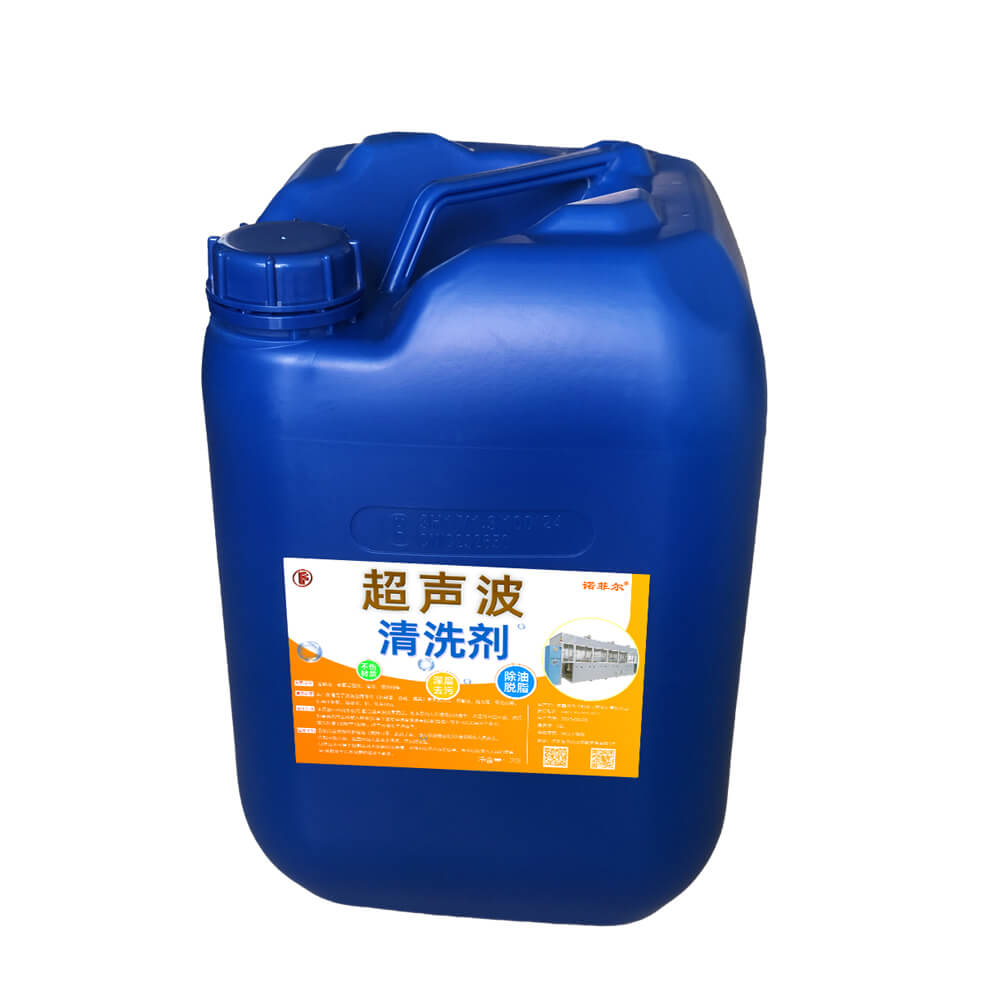
3.2 Ultrasonic cleaners: deep cleaning of complex structures
The cavitation effect of ultrasonic cleaning requires special synergistic properties of cleaning agents: adding 0.1% cavitation accelerator (e.g., low-carbon alcohol) can increase the energy of cavitation bubbles collapsing by 30%; The optimal working temperature is 40-60°C, when the cavitation strength and chemical activity are balanced, and the decontamination efficiency is the highest. The corrosion rate of the stainless steel cleaning tank is < 0.005mm/year, which extends the service life of the equipment
In the cleaning of hydraulic valve blocks, ultrasonic cleaning agents solve traditional problems: a hydraulic parts factory uses a 40kHz, 0.8W/cm² ultrasonic process, combined with a special cleaning agent, to remove the emulsion residue in the deep oil hole of 0.5mm within 20 minutes, the cleanliness reaches NAS level 8, and the installed failure rate of the valve block is reduced by 75%.
3.3 Soaking cleaning agents: flexible options for flexible treatment
The gentle nature of the soaking process gives the cleaning agent a unique design: it can be adjusted in the range of 2-10% depending on the degree of oil staining, and heavy oil stains are soaked in high concentrations for a long time (30-60 minutes); There is no selective corrosion on multi-material hybrids such as aluminum, copper, and steel, and the corrosion rate difference is < 0.002mm/year; It can be reused 3-5 times, and the concentration is maintained by adding mother liquor, and the treatment cost per kilogram is only 1/2 of the spraying process; In the mold maintenance scenario, the soaking cleaning agent shows convenience: an injection molding factory uses a 5% concentration of mold cleaning agent to soak the removed cavity for 8 hours, which can soften and strip the remaining PVC coke, eliminating the need for manual grinding and shortening the mold maintenance cycle by 60%.
Conclusion: The future evolution of cleaning technology
The development of industrial cleaning agents is moving in the direction of "precision, greening, and functionality": nanoscale particle cleaning agents can penetrate deep into micropores below 50nm; biological enzyme preparations achieve room temperature decontamination through specific reactions; The intelligent responsive cleaner automatically adjusts the activity according to the type of contaminant. These innovations not only improve cleaning efficiency but also promote the transformation of the cleaning process from "extensive" to "precise and controllable". For manufacturing enterprises, the selection of cleaning agents needs to establish a three-dimensional evaluation system of "material-contaminant-process": neutral water-based formulas are prioritized for aluminum cleaning, special low-residue products must be used for precision optical components, and ultrasonic equipment must be matched with low-foam synergistic formulas. Only by achieving this precise matching can we minimize costs and environmental risks while ensuring cleanliness. In the wave of Industry 4.0, cleaning agents are no longer simple auxiliary materials but key factors in product quality, productivity and environmental performance. Companies that are able to deeply integrate cleaning technology into their production processes are gaining an increasingly significant competitive advantage – and this is where industrial cleaning technology really values.
 苏公网安备32058302004438